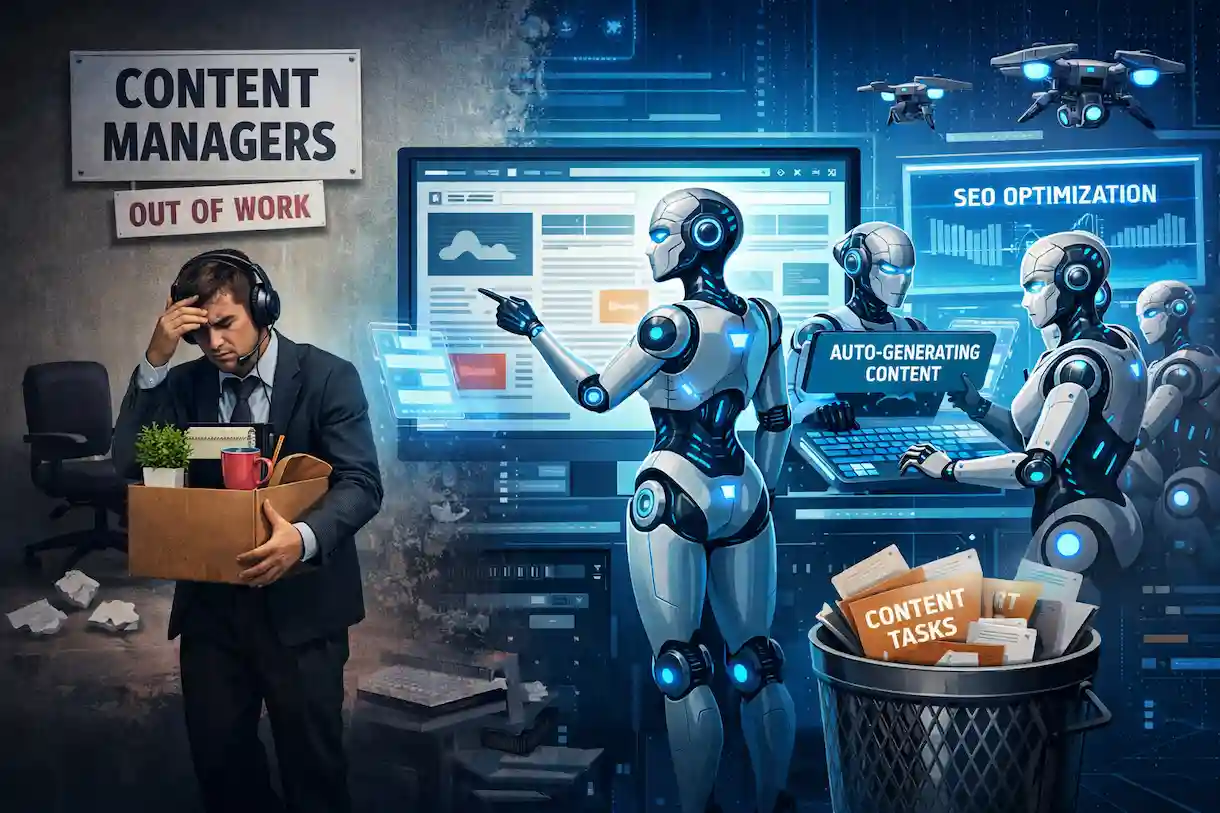
Artificial intelligence (AI), despite how mind blowing it is among other drawbacks, is sweeping through everything. At CMS MAG, we have already spoken at length about its implications and how it is going to transform content management systems (CMSs) into something entirely new and surely more powerful, usable and friendly for people with little knowledge.
The fact is that some go further and claim that with AI it is very easy to take a web project and turn it into a static page without a CMS, whether using markdown or not. Many believe that if websites are hardly updated at all, the best thing to do is this, turn the website into HTML and CSS and dispense with the CMS, JavaScript and the rest of the technologies in order to make the website much faster and more secure, among other advantages.
Before AI, the decision about whether or not to always use a CMS was easy, and the data backed it up: the recommendation was always to use a CMS given that there are already free, very powerful and very user friendly options on the market. But many claim that AI has changed the paradigm and that this choice is no longer always so clear cut.
“But for static commercial sites that change twice a year, a full CMS can be an unnecessary burden. More plugins. More updates. More security surface,” says one advocate of AI powered static websites on LinkedIn. “A CMS still makes sense for: news sites, blogs with multiple authors, ecommerce and active marketing teams. […] If AI handles content changes and engineers take care of deployment, perhaps installing a CMS first should no longer be automatic,” he continues.
Other users point more to costs. One of them, also on LinkedIn, says he will stop doing everything with WordPress because by the end of the year the costs of commercial themes and plugins pile up. This user says that by flattening websites and turning them into static versions, he saves costs, greatly improves speed, since even the database is removed, and improves security.
In the section on lost features, he points out that websites can no longer be updated by editors or people without technical knowledge and that the plugin ecosystem for complex things is also abandoned, as is the client familiarity that WordPress provides, since it is already very well known.
My opinion on doing without CMSs
Although I understand the reasons why doing without a CMS may be interesting in certain specific cases, most of the time I still do not support this position.
First, the data does not support this supposed trend. If one looks at the market share data for CMSs and how it has evolved, it is true that fewer and fewer projects are being built without a CMS, since nowadays installing an open source one is very easy and has many advantages.
Second, people say that going static takes 4 minutes. I personally very much doubt that a migration can be done properly in 4 minutes. Perhaps yes for very small sites, but on sites of any real substance, migrations are not usually simple or painless.
Third, my personal experience tells me that turning a website static becomes a nightmare when it comes time to update it. Things as simple as changing the site navigation and having that change carry across to all the pages in the project thanks to the CMS are impossible without a CMS and although AI can help a great deal with that, I had to manage it personally without AI, albeit with a partner, and afterwards the review and QA are a nightmare.
Lastly, I think that by doing without the CMS, even if AI helps a great deal to update the site, the computer engineer’s point of view is once again placed ahead of business, commercial, marketing or editorial goals. A website with a good block editor, easy to use but powerful, especially designed so that the marketing team can give free rein to its ideas and creativity without opening tickets and waiting months, should be the goal. Turning the website static may be fine in specific cases, but it should by no means be the norm.
Doing without the database also has implications. The main one is that there is no good data persistence.
* Original article written in Spanish, translated with AI and reviewed in English by Jorge Mediavilla.