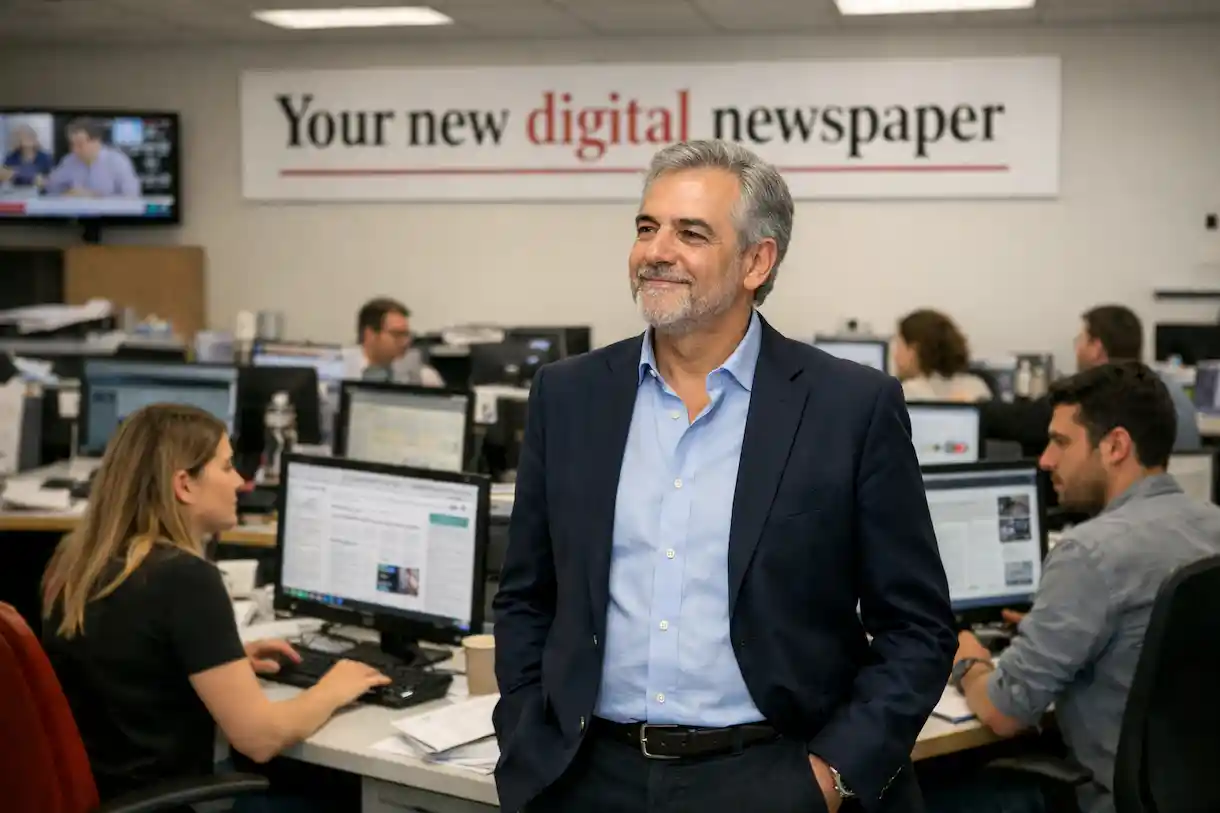
Nowadays there is a huge number of digital platforms that let you create a simple blog even for free, but in this article we are going to talk about how to create a professional digital newspaper, something that in 2026 requires a set of requirements and features that are necessary to succeed. In addition, you have to keep in mind that we are already fully immersed in the era of generative artificial intelligence (AI) and this brings some additional considerations.
Considerations before you get started
First of all, before you actually start considering which platform or CMS is the best for the project, you need to ask yourself a series of questions:
- What human resources will the project have? A newsroom of 2 people is not the same as one of 100 in different countries.
- What monthly traffic do you want to achieve in 3 months, 1 year, and in 5 years? This is essential for technical and hosting considerations.
- What features does the project have? Building a newspaper similar to those that already exist is not the same as building one that is very different and innovative.
- What monthly budget do you have? Starting a project with no budget is not the same as having at least 1,000 euros per month to have a CMS that is already functional and tailored to a digital newspaper.
At CMS MAG we always consider that solid planning work is needed before jumping into the adventure. As general advice, we recommend steering clear of offers like “create your newspaper for free” or others like “create your newspaper in three clicks”. If the budget is zero or very low, the best option is to go straight to open source code because it has multiple advantages, as we will see below (in fact, CMS MAG runs on open source code).
Essential features of your digital newspaper
Although launching a new digital media outlet may seem like a simple task, the truth is that, in our opinion, it should have at least the following features:
- It must deliver advanced performance and speed. This is what usually makes the difference when many newspapers publish very similar information. It must meet Core Web Vitals requirements.
- The system must respond well to Google’s demands and to market trends in terms of formats, channels, and so on. In other words, it must be flexible and agile.
- The chosen CMS must have a powerful taxonomy system or content categorization, and it must enable excellent organization for later retrieval and reuse.
- The editing system must be modern, a page builder that emulates the page in production, and not the classic button toolbar. Journalists should not be distracted from their main function of creating quality content; the CMS must enable very simple and intuitive design editing.
- A good content authorship system.
- An integrated analytics system to know at all times what the audience is visiting and to act accordingly.
- An advertising system to generate revenue. Many outlets have also already opted for paywalls and explore other revenue streams like branded content, events, and a long list of others.
- The system must provide a newspaper specific design.
- It must support multimedia features.
- It must include tools to distribute content effectively on social media.
- It must include strong SEO features with structured data, and so on.
- It must take security very seriously.
- The CMS must have search at its core.
- It must enable aggregation of content from wire services and other sources and content syndication.
- Contact forms.
- Comments with moderation, preferably using AI.
- Integrated AI features.
- A powerful roles and permissions system.
- Newsletter support.
- A redirects system.
- Different content types and customizable workflows.
- A live updates system, or minute by minute.
- Agile homepage management.
- Full support for legal compliance (Cookie banner, GDPR, and so on).
Ideally, the CMS should also have systems to connect easily with other third party systems, so that products like Mailchimp for newsletter, advanced third party paywalls, a solution for print, and so on can be implemented easily. This gives us great freedom to customize the digital newspaper to our liking.
To get started, the recommendation is to use a traditional content management system and not a hybrid or headless one, without a head, because although it has quite a few advantages, it adds a layer of technical complexity and cost that is not suitable for a free professional digital outlet.
Open source code to start your digital newspaper
As we mentioned a few paragraphs ago, if you are going to start a low budget project, before trying cheap proprietary CMS, we strongly recommend starting with any open source CMS. While there are many available on the market, WordPress is right now the king of the Internet in market share.
The list of open source advantages is long and varied:
- Zero license cost.
- Many have a large ecosystem and community.
- Flexibility, through plugins and extensions they can be adapted to practically almost any purpose, including a high traffic or high audience digital newspaper.
- Evolution, the community also provides updates including security updates.
- Independence, you do not rely on a private company, there is no vendor lock in, and many people know the system.
- Compatibility with modern approaches like a headless CMS and good AI integration.
- Hosting, hosting companies usually already offer special plans tailored to the major open source CMS.
- Perfect for SEO, although it requires additional plugins, and with multisite and multilingual capability.
- Some open source CMS are already well known by editors.
Many of these advantages apply to most open source CMS, with the most popular being WordPress, Joomla, and Drupal. WordPress has some additional advantages such as a larger community and a larger plugin repository, although it is not free of problems or controversy.
The AI topic, very important in 2026
If you are going to launch a digital newspaper in 2026, it should already include built in AI features or the new media outlet may be born less competitive than it should be.
Today it is very common for AI to already handle filling in the fields intended for SEO optimization, provide summaries, generate multimedia from a text, provide context, generate translations, headlines, rewrite wire copy, assist in distributing content for social media, moderate content, frame images correctly and so on.
A digital newspaper created in 2026 should already have a large part of these features and it must be agile enough to include on the roadmap more interesting AI applications such as generating its own custom GPTs, assistance with fact checking, AI agents, digital rights management, subscriber customer service and other advanced uses of AI.
Private CMS to consider
If open source CMS do not convince you for any reason or you have already tried them and it did not go too well, you can always try one of the private CMS that exist on the market.
While there are some high end options that also come with a high price, at CMS MAG we know the market in depth and we can recommend the best options in terms of quality and price. That way, you will not make a mistake and you will get an optimal CMS for you at a great price.
The importance of Google, SEO and editorial strategy
One of the biggest mistakes many new digital newspaper directors make is not taking Google into account, which is a big mistake because it generally represents a large percentage of the traffic media outlets receive. That is to say, it is a major channel through which traffic arrives. Other major channels used to be social media, but those networks decided some time ago not to send much traffic.
Although it is true that Google is shifting thanks to AI and it increasingly tends to keep more and more traffic, it can still send considerable traffic, so it is worth keeping it very much in mind and relying on professionals and optimized strategies to capture traffic from Google Search and Google Discover.
Other major traffic sources, although usually at a different level, tend to be newsletters or direct traffic if you manage to build a strong brand, among others. In this respect it should be clarified that a digital newspaper is a difficult and complicated business that will require large doses of patience and a commitment to quality to move forward.
Measure and you will win
You must not make the mistake of launching a digital newspaper in 2026 and not measuring all the key business indicators properly. The most used analytics systems, which may be Google Analytics or Adobe Omniture, will provide you with the basic data on unique users, page views and so on. This is fine to get started.
Generating and acquiring traffic is an important part of the work of any media outlet, but in addition you will need to measure and work hard to build engagement or loyalty, which can be measured by the time users spend on the site and the number of page views per user, for example.
Modern measurement systems also make it possible to set up valuable dashboards so you can see how the media outlet is performing at a glance.
In addition, and given that on the Internet everything can be measured, it will be really useful to configure and track certain events to which you can assign conversions, so that the business is well controlled, which may have alternative funding paths beyond conventional advertising.
The team you need for your newsroom
Considering all of the above, newsrooms, even small ones, usually have an editorial director and several editors who, obviously, produce the content thanks to their professional skill supported by AI.
In addition, there is usually someone specialized in social media, as well as an SEO specialist and a senior person who can act as the person in charge of the CMS. Newsrooms are not always well staffed and in many cases the editors themselves not only write, but also take on these other tasks.
Depending on the nature of the outlet, there may be different sections and professionals specialized in them, such as opinion or sports. There are usually full time staff writers and, additionally, a good number of freelance professionals. There is no general rule in this respect, each newsroom and digital newspaper is its own world in this sense.
With the arrival and mainstreaming of paywalls, professionals specifically dedicated to these tasks are being hired. Opportunities are also emerging around branded content, for example, which also tends to require dedicated specialists.
* Original article written in Spanish, translated with AI and reviewed in English by Jorge Mediavilla.