If you are looking for how to bypass this or that newspaper’s paywall, you can go back the way you came, because this article is not about that, but about how to enable or create a free paywall for a digital newspaper, and which is the best one if you have hardly any budget (for big media outlets and press organizations there are several paid options available with different prices).
All digital roads lead to Rome, which is none other than Google, when it comes to free digital products. Unfortunately, if you want a free paywall for your digital newspaper you will once again have to hand your data to the Mountain View giant. As if it did not already have little enough data about us and our businesses! If this issue does not affect you too much and you really need a free paywall to try to keep your publishing business afloat, then the solution is Google Reader Revenue Manager (GRRM).
Reader Revenue Manager, Google’s free paywall
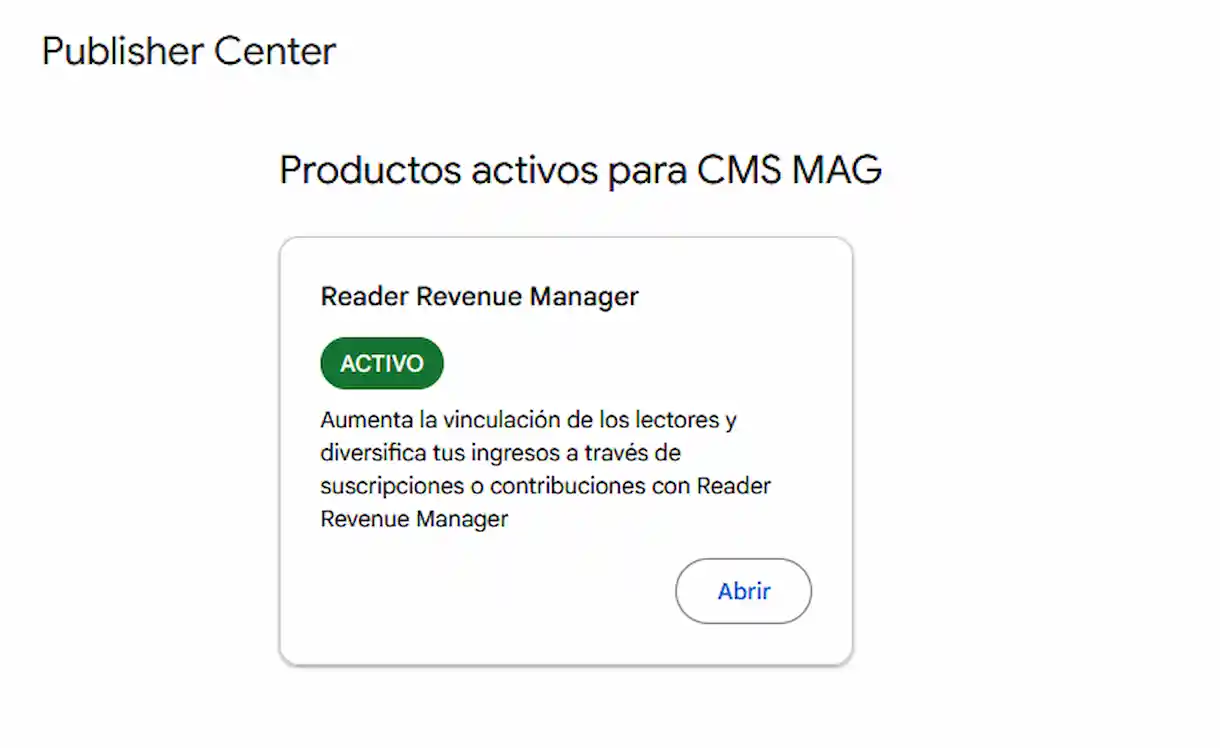
In fact, at CMS MAG we have been using Google Reader Revenue Manager for years now. We reported on it when it launched and we actually analyzed it at the time and then we left it enabled. The purpose of this article is not to analyze again this free paywall that Google makes available to everyone subject to its approval, but we are going to comment on how it has improved in recent times.
Improvements arrive, but very slowly, drip by drip, so we consider that there are not too many resources invested in a project that probably points more to a PR cleanup by Google (since it is depriving the press of a large part of its audience with AI Overviews, AI Mode in Google Search, the latest core updates to Search and the changes in Google Discover) than to a genuine interest in preserving journalism and democracies.
Be that as it may, and leaving the above aside, we are going to focus on the product itself. It is still, as at the beginning, quite easy to set up and use and it also has good documentation and support. It can be configured as a paywall, but also as a registration wall and in many other ways.
Precisely one of my criticisms in late 2023 was the lack of options, but nowadays they have introduced some improvements, such as the possibility of configuring open content differently from closed content. Recently, in addition, they have reorganized the workflow and split it into conversion funnels, on the one hand and, on the other, a library of CTAs (Call to action or call to action elements and forms).
CMS MAG, for example, is configured to let you view some content for free and then require registration to keep viewing for free. Subsequently, a subscription is required, but it could also be configured to obtain user data through surveys or to offer more content in exchange for viewing ads.
Paywalls for WordPress and open source
GRRM is a free paywall that works for all web content management systems (CMS) and is increasingly popular, but perhaps it is not a good idea to give Google more power in the media. If you use WordPress or other open source CMS you surely have plugins and extensions available at a very good price that, even if they are not free or do not offer all the functionality for free, can be a great alternative to Google Reader Revenue Manager.
There are many paywalls available in the official repository. Perhaps the most popular are MemberPress, Paid Membership Pro or Restrict Content Pro. And the same is true for Joomla with RSMembership! or Membership Pro.
Types of paywalls
When choosing and setting up a paywall, you have to take into account the types that exist in the market and how they can be configured. Depending on the restrictions imposed by the paywall, we can talk about several types:
• Hard paywall: This paywall is falling out of use because it means closing all content to all readers unless they subscribe. Nowadays they are seen as too aggressive.
• Metered paywall: This model allows you to view a certain number of articles for free, a set number. Once you exceed that figure, the media outlet then requires some type of subscription.
• Freemium paywall: n this model low value content is offered for free, and the content that took a lot to produce or obtain, such as investigations or interviews, is what sits behind the paywall. Sometimes this model is combined with the previous one.
• Dynamic or personalized paywall: With the arrival of artificial intelligence (AI) and greater awareness of first party data, a new generation of dynamic paywalls is emerging that precisely offers personalized options and offers to the user depending on the type of user or cohort they belong to.
Depending on where the access rights check is performed, it is possible to distinguish between two systems:
• Server side paywall: In this model, which would be the ideal, it is the server that is responsible for validating whether the reader has the right to enjoy that article or not. If they do not have the right, it is not served or it is served directly with restrictions. This paywall would be native to the CMS.
• Client side paywall: With this system, weaker than the previous one, the content loads in the user’s browser and the blocking is managed via JavaScript, cookies or other systems that are easier for the user to bypass.
A free paywall will certainly use this latter system, since the other is more technically complex and few CMS have it.
Paywalls, SEO and advertising
Implementing a paywall is not only a content restriction decision because it can affect the newspaper as a whole. First, many decisions are made taking into account the forecast of paywall earnings versus the forecast of advertising loss that may occur. In any case, with programmatic advertising producing less and less revenue, the decision to bet on the paywall is increasingly easier in this regard.
And, on the other hand, implementing a paywall in many cases means getting worse metrics in terms of loyalty and “engagement”, something that Google also takes into account in Google Search.
But before that, it is necessary to entrust the implementation task to technicians well versed in the matter to restrict content to users as appropriate, but not to Google, which must be able to continue accessing the content if we want to keep getting traffic from Search and Discover.
Key features of paywalls
If you choose a free or very cheap paywall, it may lack many functions that are common in high end newspaper paywalls. First, it is important that it is very flexible, because the job of the person in charge of subscriptions in many cases is to make small changes and measure results, either with the famous A/B tests or by making larger changes. Sometimes large media outlets have decided to move from one type of paywall to another depending on results or market trends.
The paywall should preferably be no code, that is, very intuitive and easy to use, since to a large extent those who typically operate it are not technical engineers and they must be able to use it quickly.
It should make it easy to change texts, offers, discounts and even sometimes decisions are made based on current events. Not a few newspapers open up all their content when a tragedy of great magnitude occurs that shocks the entire country to highlight their spirit of service to society.
And, on the other hand, although free paywalls do not usually offer this either, it is to obtain metrics on everything that happens around the paywall. At this point I mean metrics such as how many times the subscription popup has been shown, what exactly the user did, which paywall caught the user’s attention (sometimes the native wall and Google’s coexist), at what point the user abandoned the purchase and a long etcetera.
In addition to AI integration, the major private paywalls for high audience digital newspapers stand out when it comes to introducing complex rules to manage rights. Also because they use first party data to segment audiences well to offer the best chance of conversion.
Another key point, since it is vital for the newspaper, is that these implementations do not severely affect performance and speed. Each newsroom must take this latter aspect into account, as well as price and complexity in implementation and use, in order to make a decision about the paywall.
The best private paywalls
The purpose of this article is not to make a list and an extensive study of the private paywalls on the market, but if you need advice on the matter, please contact us and we will be happy to help you with your publishing project.
* Original article written in Spanish, translated with AI and reviewed in English by Jorge Mediavilla.