Following the initial announcement, at CMS MAG we wanted to delve a little deeper into WP Engine’s new offering aimed at medium and large newsrooms and content creators: WP Engine Newsroom. To that end, we attended a product demonstration to see its unique features.
The product is built for WordPress, to which a new layer has been added that enhances its design, adds new functionalities and some interesting blocks, all of it built in house by WP Engine after the acquisition of Big Bite to ensure performance and quality.
The first thing that stands out at the top of the backend editing page is a set of shortcuts in which WP Engine Newsroom separates certain elements onto an independent page, such as metatag management, authorship, etc. From this other page, always connected to the editing page, taxonomy is also managed, among other things.
Another specific feature of this CMS is the checklist displayed before publishing. Each company can create its own list and within it, the editor can verify whether everything is ready for publication or the system notifies them that elements are missing or that there are items that need refinement. Some of the items on the list can be configured to block publication of the article if they are considered that important or essential.
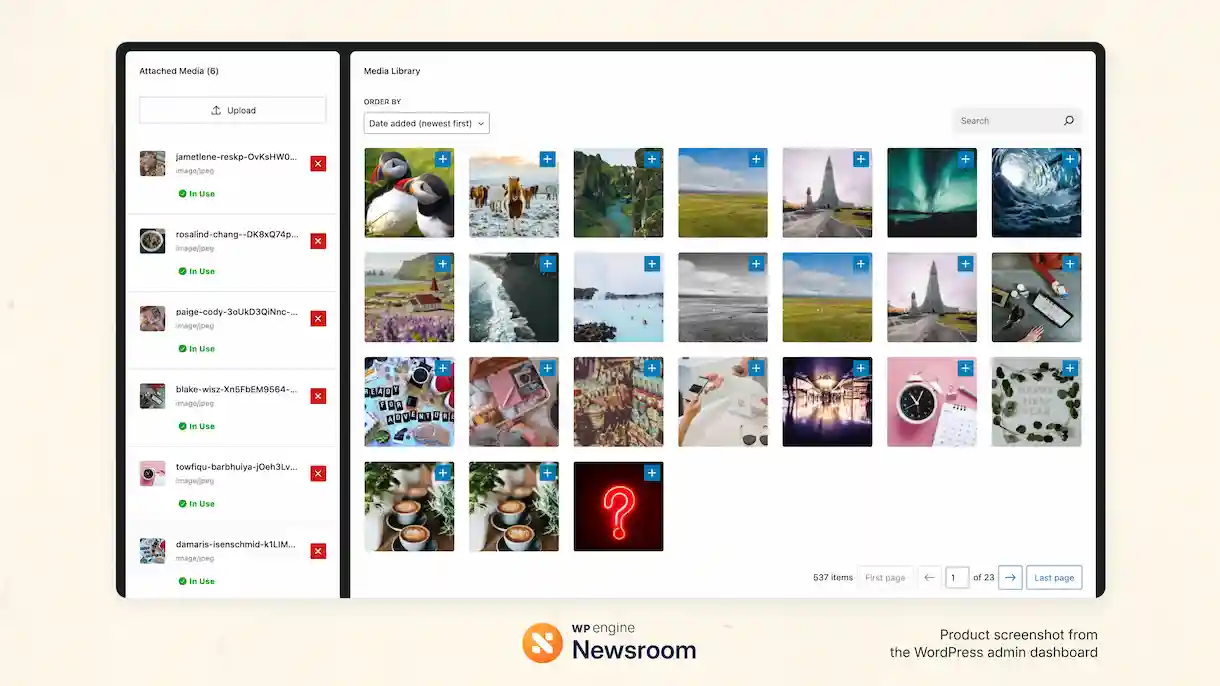
One of the areas that has seen the greatest improvement is multimedia. We were shown several enhancements to the main image, where different aspect ratios could be applied and the focal point could also be adjusted slightly. Perhaps the most notable feature, however, is the integrated DAM (Digital Asset Management), where all images accessible to the media outlet can be stored and configured for efficient multimedia retrieval.
Improvements to linking were also demonstrated. Likewise, we were shown that the collaborative editing system is truly advanced (with block level locking), something that is also being heavily developed in the open source version of WordPress. We were able to see a toggle that enables this feature and highlights the paragraph each editor is working on and it is also possible to edit other pages related to the entry.
Another new feature related to the above is the possibility of performing a soft delete. This means that you can delete part of an article, but that portion remains stored and by means of a toggle it can be displayed again even though it has been deleted. This is useful for easily understanding how an article looked before its editing.
The revisions system was also demonstrated, showing how it is easier and more intuitive for editors to review changes and revert to a previous version if necessary.
Work has also been done on data flow and publishing. It was observed that WordPress’s default “Save” button is not very indicative of whether the article is published or not, so the workflow has been improved so that this button produces a draft instead of publishing directly. This is indeed the case in many CMS.
Interestingly, the WP Engine team also has a collaborative tool for covering live events, something I usually only see in the highest end CMS specialized in major media organizations.
Many more elements were shown, such as the different blocks that have been prepared, including one for lists in the form of a photo gallery, another for polls and contests, integrated advertising… They are even working on their own analytics tool.
In summary, this is WP Engine’s premium version of WordPress. When I asked whether this product competes more with Newspack or with WordPress VIP, WP Engine representatives expressed pride in reaching both worlds with their product, local newspapers and large newspapers and companies alike.
Perhaps what is missing is a stronger presence of artificial intelligence, so fashionable lately in CMS, to the extent that even our own annual event, Ainnovación, relies on this revolutionary element.
Everything shown has been built in house, although WordPress remains at its core, with all the advantages that entails. The product has not been conjured up overnight, but rather is the result of more than two years of joint work with several clients and it appears robust and stable from the outset.
Now all that remains is to subject WP Engine Newsroom to market scrutiny. Although we know it operates with a monthly fee, we do not know the amount involved and this is vital in a highly saturated and challenging market. Google has decided to use artificial intelligence (AI), specifically AI Overviews and the changes it is making to Google Discover, to drain a significant amount of traffic from media outlets and this is generating a new crisis in an industry that is already highly saturated and impoverished.
As reported by The Repository, Newsroom includes WP Engine hosting as well as the ACF Pro plugin, owned by WP Engine and the Smart Search artificial intelligence toolkit, along with other tools.
The future lies not only in improving the editorial layer, but in something arguably even more important, monetization and performance, with A B testing, etc.
* Original article written in Spanish, translated with AI and reviewed in English by Jorge Mediavilla.