GfK DAM, the measurement provider recommended by the industry, invited a group of journalists to review the impact of generative AI and chatbots in Spain using data from its digital measurement. The data could not be clearer and shows that users still want to stay informed, but not so much through the media outlets themselves. And unfortunately, the bad news does not end here…
The success of this technology is, therefore, enormous and contrasts completely and absolutely with a conversion rate to media outlet visits of just 0.73% (this is for ChatGPT, because for the rest of AI systems this rate is even lower).
The evolution of generative AI in Spain, and specifically of ChatGPT, which is the undisputed leader, at least in Spain, could not have been faster or more profound. Today, it has a penetration rate close to 60%, but it reached 40% in just 2 and a half years, while the Internet itself took 15 years to reach that penetration rate.
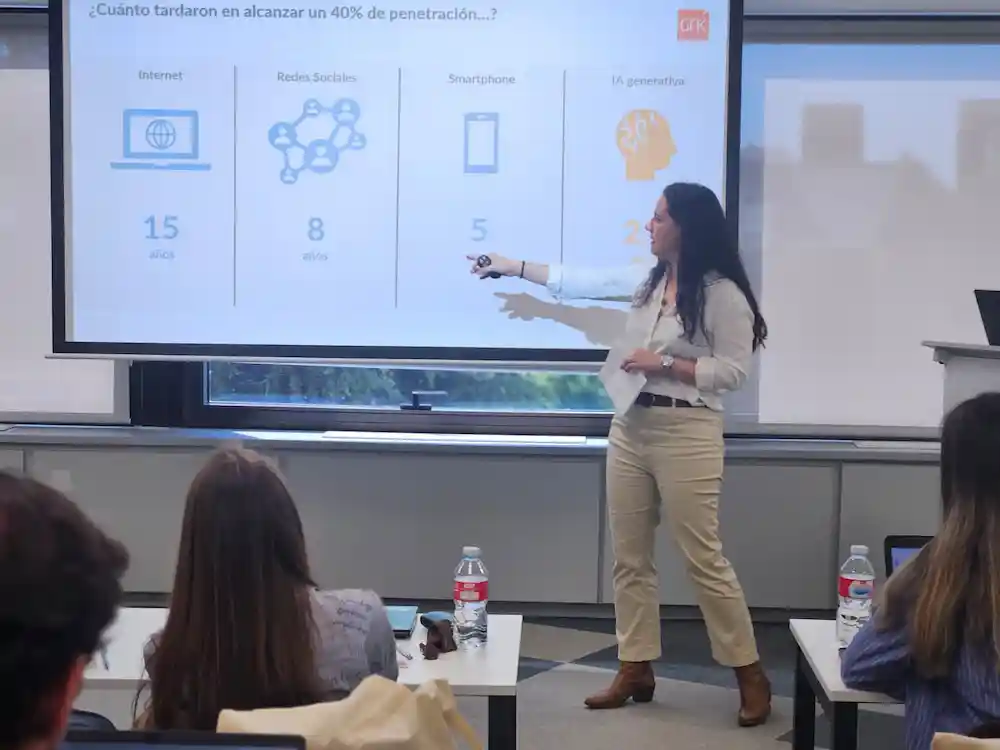
Therefore, with the data from the official measurement provider in hand, the media and the open web in general are suffering a perfect storm. The use of chatbots is increasing while it is being shown that they send practically marginal traffic. This is compounded by changes in Discover, AI Overviews, core updates that prioritize Reddit and YouTube, among other factors, and it is easy to understand why the open web is having such a hard time.
It seems that only legislation by the European Union (EU) and our Government, through the CNMC, is the only hope to prevent more local media outlets and newspapers from closing in Spain. Fortunately, there are already moves in this direction in the EU to protect democracy and truthful, free and independent information.
In terms of solutions, few have been proposed, because quite simply they do not exist, but it has been mentioned that GfK DAM intends to measure citations made to media outlets from chatbots, so that these can be valued before advertisers.
The outlook, therefore, is bleak for the media and for the open web, especially if they depended heavily on so called “evergreen content”, since this is what has fallen the most because AI answers it perfectly.
The need to stay informed still exists, but it is no longer carried out so much through the media, which do continue to play a major role on the Internet in terms of visits, but not so much in time spent, which is only 4% of total user time. Audiences clearly spend more time on social media, communications apps and OTT, for example.
Finally, it should be noted that ChatGPT is the undisputed leader of AI in Spain and is used by almost 19 million people (March 2026 data). Gemini, taking advantage of Google’s monopoly position, rises to 8.84 million, although these same users continue to use ChatGPT and use Gemini and other AI systems as a complement to OpenAI’s technology. Claude, which has so many fans lately, does not reach 1 million users in Spain.
To conclude, GfK DAM revealed to us its intention to continue being the reference measurement provider in Spain, as it has been until now. To do so, it now proposes also measuring connected TV and chatbot citations, as we saw earlier. Regarding my question about its view on measuring digital newspapers and social media together, it was categorical and supports the position dictated by common sense, which is that it makes no sense. It will measure the impact of social media on traffic, but it will offer it in a disaggregated way. The opposite would be to reward social networks that are quite wild and that media outlets do not control and can barely monetize.
* Original article written in Spanish, translated with AI and reviewed in English by Jorge Mediavilla.